The Masnavi: Epic Spiritual Narrative in Persian Poetry
The Form Built for Epic Journeys
If the ghazal is the lyric gem of Persian literature, the masnavi is its epic cathedral. Where the ghazal achieves intensity through compression, the masnavi achieves its effects through expansion. It is a form designed for duration, for narrative complexity, for the gradual unfolding of spiritual or ethical truth across thousands of couplets and many hours of reading.
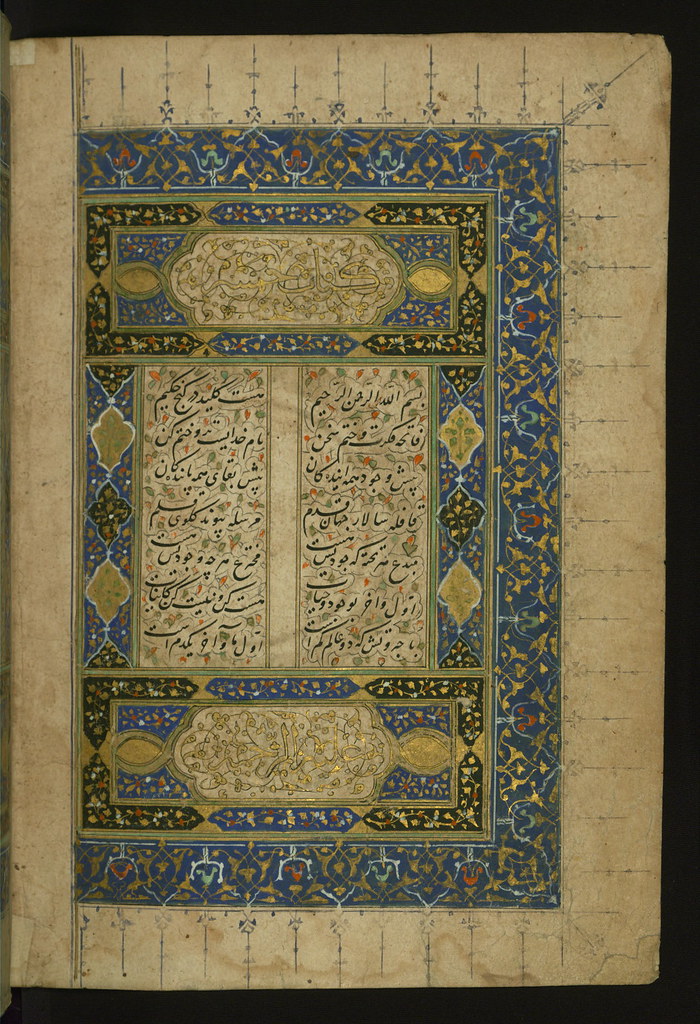
The masnavi (مثنوی, also transliterated as mathnawi) takes its name from the Arabic root for “two” or “double,” a reference to the form’s defining structural principle: each couplet (bayt) rhymes internally, pairing its two hemistichs with a shared rhyme sound, and the next couplet then introduces an entirely new rhyme. The scheme is therefore AA BB CC DD, progressing indefinitely. This internal couplet rhyme, rather than a sustained end rhyme running through the whole poem, is precisely what distinguishes the masnavi from the ghazal and makes it suitable for works of enormous length.
Formal Structure
In a masnavi, the poet is not bound to maintain a single rhyme for the duration of the work. Each new couplet can pivot to a fresh rhyme pair, allowing the poem to accommodate any subject, any digression, any extended parable without straining against formal constraint. The meter, however, remains fixed throughout any given masnavi, providing the unifying pulse that holds thousands of couplets together into a single continuous experience.
The masnavi poet’s challenge is not the technical one of sustaining a difficult rhyme (as in the ghazal) but the artistic one of maintaining coherence and momentum across vast scope. How does one prevent a poem of 26,000 couplets from dissolving into chaos? The answer, in the great masnavis of the tradition, is the masterful use of interlocking narrative: stories embedded within stories, digressions that illuminate the main theme from unexpected angles, and a governing philosophical or spiritual intention that gives every digression its ultimate relevance. A masnavi that lacks this governing intention degenerates into mere accumulated storytelling. One that possesses it becomes an inexhaustible world.
The Masnavi Versus the Ghazal
The contrast between these two forms maps onto a contrast between two modes of poetic intelligence. The ghazal poet is above all a lyricist, working within exquisite constraint to produce concentrated emotional and spiritual force in a handful of couplets. The masnavi poet is above all a narrator and teacher, using the flexibility of the form to conduct the reader through extended journeys of meaning.
This does not imply that masnavis lack lyric moments. Quite the contrary: the greatest masnavis contain passages of lyric intensity that rival anything in the ghazal tradition. But in the masnavi, such passages are embedded in narrative context, illuminated by the story surrounding them, and are themselves vehicles of larger argument. The lyric moment in a masnavi is always doing double duty: it must move the reader emotionally and simultaneously advance the philosophical project of the whole.
Rumi’s Masnavi-ye Ma’navi: The Sufi Epic
No masnavi is more celebrated or more studied than the Masnavi-ye Ma’navi (مثنوی معنوی) of Jalal al-Din Rumi (1207 to 1273 CE). Composed over many years in Konya (in present-day Turkey), at the urging of Rumi’s devoted disciple Husam al-Din Chalabi, the work extends across six volumes (daftar) and approximately 25,000 to 26,000 couplets. Later admirers called it “the Quran in the Persian tongue,” a description that speaks not to any claim of prophetic authority but to the poem’s perceived spiritual completeness and inexhaustible depth.
The Masnavi opens with an 18-couplet prologue known as the Nay-nameh (نینامه), the Song of the Reed. This opening is among the most celebrated passages in all of Persian literature. The image of the reed flute cut from its reed bed becomes the central metaphor for the human soul, separated from its divine origin and crying out for reunion:
بشنو این نی چون شکایت میکند از جداییها حکایت میکند
Listen to this reed, how it tells a tale of separation / Of severed bonds it speaks, this its lamentation.
The opening imperative “Listen!” (beshno, بشنو) is not merely a request addressed to a reader. It is a summons to a mode of receptive attention that Rumi considered the precondition for all genuine spiritual understanding. The reed has a message, but the message can only reach one who has become quiet enough to receive it.
The following couplet deepens the image:
کز نیستان تا مرا ببریدهاند در نفیرم مرد و زن نالیدهاند
Since from the reed-bed they severed me away / Both man and woman have wept at my lamenting cry each day.
The reed’s separation is universal. Its grief is not private but a mirror for all human longing: every man and woman who hears the reed’s cry recognizes their own estrangement from something essential. This is the genius of the metaphor and the reason it has endured for 750 years. Rumi speaks of something particular (the cut reed) and means something cosmic (the separated soul).
The Nay-nameh then gives the Masnavi’s governing theological claim its most concentrated formulation:
هر کسی کو دور ماند از اصل خویش باز جوید روزگار وصل خویش
Everyone who is kept far from their origin / Seeks once more the age of reunion to begin.
This single couplet could serve as a summary of all six volumes. Every story, every parable, every philosophical digression, and every lyric outburst in the Masnavi-ye Ma’navi is, in some sense, an exploration or illustration of this foundational principle: every being longs for its source, and that longing is the engine of all spiritual life.
Rumi also gives the fire metaphor its definitive expression in the Nay-nameh:
آتش عشقست کاندر نی فتاد جوشش عشقست کاندر می فتاد
It is the fire of love that has fallen into the reed / It is the ferment of love that has fallen into the wine indeed.
Love here is not sentiment but a metaphysical force. The same energy that makes the reed cry also makes the wine ferment. Both music and intoxication are manifestations of a single underlying vitality. This theological move, identifying love as the fundamental principle of all animation, is central to Rumi’s Sufi vision and recurs throughout the six daftars of the Masnavi.
The Architecture of Digression
One of the most striking features of Rumi’s Masnavi is its use of nested narrative. A story begins, then is interrupted by a parable; the parable branches into an anecdote; the anecdote leads to a philosophical reflection; and then, several hundred couplets later, Rumi returns to the original story, now visible in an entirely new light. This technique is not carelessness or loss of focus but a deliberate structural strategy. Each digression adds a layer of meaning to what surrounds it, the way a series of mirrors can illuminate a room from unexpected angles.
The Masnavi also contains extended passages of dialogue, often between a seeker and a spiritual master. These dialogues are among the most psychologically subtle explorations of the teacher-student relationship in any literary tradition. Rumi is acutely aware of the limits of verbal instruction and frequently has his speakers demonstrate the failure of language even as they use language to do so. The form acknowledges its own paradox: a book about the limitations of books.
Saadi’s Bustan: Ethics in Masnavi Form
Saadi of Shiraz (1210 to 1291 CE) employed the masnavi form to very different ends in his Bustan (بوستان, “The Orchard”), completed in 1257 CE. Where Rumi’s masnavi is mystical and digressive, Saadi’s Bustan is ethical and lapidary. Each story is a parable, and each parable illuminates a moral principle. Saadi opens the Bustan with an invocation that is itself a model of the classical masnavi’s register:
به نام خداوند جان آفرین حکیم سخن در زبان آفرین
In the name of the Lord who creates the soul / The Sage who brings speech to the tongue, making language whole.
The invocation establishes the poem’s theological grounding: language itself is a divine gift, and the poet’s task is to use that gift with wisdom and responsibility. Throughout the Bustan, Saadi deploys the masnavi’s formal freedom to move nimbly between stories, from a tale of a king to a meditation on justice to an anecdote about a dervish, always with elegant transitions and always in service of his ethical teaching. The Bustan was a required text in Persian educational institutions for centuries, and Saadi’s clarity of moral vision made it as much a book for children as for scholars.
Attar’s Conference of the Birds: Spiritual Allegory in Masnavi Form
Farid al-Din Attar of Nishapur (approximately 1145 to 1221 CE) used the masnavi form to compose one of the most enduring spiritual allegories in any language: the Mantiq al-Tayr (منطق الطیر, “The Conference of the Birds”). In this poem, a multitude of birds set out on a journey to find their king, the mythical Simurgh. Each bird represents a spiritual obstacle or attachment, and the journey through seven valleys (the valleys of Search, Love, Gnosis, Detachment, Unity, Bewilderment, and Annihilation) becomes a map of the Sufi path toward divine union.
The conclusion is among the most celebrated in Persian literature. When the thirty surviving birds (si morgh, سی مرغ) finally reach the Simurgh’s court, they discover that they themselves are the Simurgh. The pun is untranslatable but essential: “si morgh” means thirty birds in Persian, and “Simurgh” is the divine king they sought. Seeker and sought are one.
The masnavi form is ideal for this journey narrative. The changing rhyme pairs mirror the changing landscapes and challenges of the spiritual path, while the sustained meter provides the sense of continuous forward motion: a pilgrimage that cannot be stopped, turned back, or paused indefinitely. Where the ghazal would have given Attar a series of lyric snapshots, the masnavi gives him a road.
The Masnavi’s Enduring Legacy
Rumi’s Masnavi-ye Ma’navi has been translated into dozens of languages and remains one of the most widely read works of Persian literature in the world today. Its influence on subsequent Persian, Turkish, and Urdu poetry is incalculable. Saadi’s Bustan shaped the ethical imagination of the Persian-speaking world for centuries. Attar’s Mantiq al-Tayr has inspired writers and artists from medieval Persia to contemporary global literature.
What all these works share, beyond the formal feature of the self-rhyming couplet, is a conviction that poetry is not merely ornament but a vehicle for the transmission of wisdom, a form of spiritual instruction in which the pleasure of the verse and the depth of the teaching are inseparable. Rumi articulates this conviction explicitly in the Masnavi itself:
روزها گر رفت گو رو باک نیست تو بمان ای آنک چون تو پاک نیست
If days have passed, say: let them go, there is no fear / You remain, O you whose like in purity does not appear.
Time passes, stories are told and exhausted, but the essential truth that the stories were told to approach endures beyond them. The masnavi, at its best, is the form that tries to contain and transmit that essential: a truth that outlasts every parable constructed to approach it. It is a form built not for the brief lyric intensity of a single illuminated moment but for the long, patient journey toward understanding that is the shape of a life.