Attar's Conference of the Birds: The Journey to Divine Love
The Birds Assemble: Farid ud-Din Attar and the Quest for the Simurgh
Sometime in the late twelfth century, in the city of Nishapur in northeastern Iran, a poet and mystic named Farid ud-Din Attar composed a work that would alter the course of Persian literature forever. Born around 1145 CE, and living until approximately 1221 CE (when, according to tradition, he was killed during the Mongol sack of Nishapur), Attar spent his life as an apothecary (the name “Attar” means perfume-seller or herbalist) while devoting his mind and spirit entirely to mystical verse. His consuming theme, to which he returned in work after work across a long lifetime, was a single question that admits no easy answer: how does a self that is tangled in its own smallness find its way back to the infinite source from which it came?
His masterpiece, the Mantiq al-Tayr (منطق الطیر, “The Conference of the Birds” or more literally “The Language of the Birds”), is an allegorical epic of roughly 4,500 couplets. In it, all the birds of the world gather under the leadership of the hoopoe (the hud-hud, the bird of Solomon) and set out on a journey to find their king, the mythical Simurgh. The poem is simultaneously a work of literary art of the highest order and a map of the soul’s return to God, written in a language of breathtaking beauty and devastating spiritual honesty.
The Simurgh: When the Goal and the Traveler Are One
The central image of the poem, the Simurgh (سیمرغ), is one of Persian literature’s most resonant symbols. In pre-Islamic Iranian mythology, the Simurgh was a great, wise bird said to have lived for thousands of years at the summit of Mount Qaf, the cosmic mountain encircling the world. Attar transforms this mythological figure into a symbol of the divine, or more precisely, of the divine ground that underlies all apparent reality.
The journey to reach the Simurgh is long, perilous, and crushing. Of the thousands of birds who set out, only thirty survive to the final valley. When these thirty bedraggled pilgrims finally arrive at the court of the Simurgh, they discover something that shatters and completes them simultaneously. Gazing into the court, they see only themselves reflected back. The Simurgh is them, and they are the Simurgh.
Attar’s Persian encodes this mystery in a wordplay that cannot be rendered in translation: “si murgh” means “thirty birds,” and “Simurgh” is the divine king they sought. Seeker and sought, lover and beloved, creature and Creator are not two things separated by an unbridgeable distance. They are one reality, seen from two angles of vision.
This is the doctrine of fana (فنا, annihilation), the cornerstone of Sufi metaphysics. The self does not travel to God as one country might send an ambassador to another. The self dissolves into God, like a drop of water that falls into the sea and discovers it was always the sea.
Attar captures this consuming love in some of his most incandescent verses:
از می عشقت چنان مستم که نیست تا قیامت روی هشیاری مرا
“So drunk am I with the wine of your love, that till the Day of Judgment sobriety has no face for me.”
The intoxication described here is not a metaphor for pleasure. It is a description of a state in which ordinary consciousness, with its distinctions between self and other, subject and object, has been dissolved. Hushyari (هشیاری), sobriety or wakefulness, represents the ordinary ego-consciousness that Attar seeks to abandon. Until the end of time itself, he declares, he will remain in this blessed ruin.
The Seven Valleys: A Cartography of Mystical Experience
Before the birds reach their destination, they must traverse seven valleys, each representing a stage on the path of mystical development. Attar’s schema became one of the most influential frameworks in Sufi literature, cited, elaborated, and debated for centuries after his death.
The first valley, Quest (talab, طلب), is where the journey begins. The seeker must abandon comfort and security, lighting an inner fire of longing that consumes everything ordinary. Many birds refuse this first valley, offering elaborate excuses: the nightingale is too devoted to the rose, the parrot too attached to the hope of immortality, the hawk too proud of its proximity to the king. Attar treats these refusals with gentle but incisive irony. The obstacles to the spiritual path, he observes, are almost always dressed in the language of virtue and attachment to beautiful things.
The second valley, Love (ishq, عشق), is where reason surrenders its throne. Attar writes:
ای مرا یک بارگی از خویشتن کرده جدا گر بدآن شادی که دور از تو بمیرم مرحبا
“O you who have utterly severed me from myself, if dying far from you brings joy, then welcome.”
This is not romantic hyperbole. It is a description of the phenomenology of mystical love, the experience in which the self is “severed from itself” and finds, in that very severance, a paradoxical wholeness. The lover who is willing to die far from the beloved, and to call that death welcome, has passed beyond the ordinary calculus of pleasure and pain.
The third valley, Knowledge (marifat, معرفت), opens the inner eye. This is not discursive knowledge, not information that can be stored and retrieved. It is the gnosis that arrives when the ordinary categories of knowing are dissolved. The fourth valley, Contentment (istigna, استغنا), teaches the seeker to need nothing, to rest in a detachment that is not coldness but fullness. The fifth valley, Unity (tawhid, توحید), is where multiplicity begins to resolve into oneness. The sixth valley, Bewilderment (hayra, حیرا), is where even the best maps fail, and the traveler stands in a dizzying recognition that the journey has no ordinary destination. The seventh valley, Annihilation (fana, فنا), is the final dissolution, the falling of the drop into the ocean.
Attar’s longing in these valleys is expressed with characteristic intensity:
ز آرزوی روی تو در خون گرفتم روی از آنک نیست جز روی تو درمان چشم گریان مرا
“In longing for your face I bathed my face in blood, for nothing but your face can cure these weeping eyes of mine.”
The word “rouy” (روی) in Persian operates on multiple levels simultaneously. It means face, direction, and surface. When Attar writes of the “face” of the beloved, he is describing the divine as a direction the soul turns toward, a surface that reveals and conceals the infinite, and a face that is the most intimate form of divine presence.
Shikva and Surrender: The Two Faces of Attar’s Devotion
What distinguishes Attar from more systematic Sufi theorists is his willingness to dwell in the tension of love rather than resolve it too quickly into doctrine. He does not only describe the sweetness of union. He lingers in separation with an almost paradoxical tenderness:
گفتم اندر محنت و خواری مرا چون ببینی نیز نگذاری مرا
“I said: in affliction and humiliation, even when you see me, you leave me behind.”
This complaint (shikva, شکوا) is itself a form of intimacy. The lover who accuses the beloved of neglect is still in relationship, still oriented toward the beloved. Attar understands that even the experience of divine abandonment is a form of divine attention, that the cry of separation is itself a mode of connection.
And yet his poetry is never merely melancholic. There is a strain of fierce, almost defiant joy in it. In one of his most striking declarations, he overturns the conventional pieties of religious practice:
چون نیست هیچ مردی در عشق یار ما را سجاده زاهدان را درد و قمار ما را
“Since no one proves worthy in love for our Friend, let the ascetic’s prayer-rug belong to them, and pain and the gamble to us.”
The prayer-rug (sajjada, سجاده) is the emblem of conventional religious virtue and disciplined observance. Attar, speaking in the persona of the true lover, rejects it. The gamble of love, with its risks of loss and humiliation, is more valuable than all the careful virtue of the ascetic. This is not a rejection of religion but a penetration to its inner core: the claim that genuine devotion involves risk and surrender, not calculation and self-protection.
The Zulf of the Divine: Beauty as Gateway
One of Attar’s most distinctive images is drawn from the vocabulary of the beloved’s physical appearance. In a poem addressed to the divine, he writes of the beloved’s hair and face in terms borrowed directly from ghazal poetry:
ز زلفت زنده میدارد صبا انفاس عیسی را ز رویت میکند روشن خیالت چشم موسی را
“From your tress the morning breeze keeps alive the breath of Jesus; from your face, the vision of you illumines the eye of Moses.”
The tress (zolf, زلف) of the divine beloved carries the life-breath of Christ on the morning wind; the face of the beloved illumines the inner eye of Moses. Attar draws on the two great prophets of the Abrahamic tradition (Jesus as the spirit of God, Moses as the one who beheld the divine without perishing) to suggest the overwhelming power of divine beauty. This is the doctrine of tajalli (تجلی, divine self-disclosure): the beautiful beloved is not a distraction from God but a site where God becomes visible.
Attar’s Legacy: Seven Cities of Love
The influence of Attar on subsequent Persian and Islamic literature is difficult to overstate. Rumi, the other towering figure of Persian Sufi poetry, openly acknowledged his debt. In a famous quatrain, Rumi declared that Attar had traversed the seven cities of love while Rumi himself was still at the first bend of the road. The structural allegory of Mantiq al-Tayr, the journey of souls through graduated stages toward divine union, echoes throughout the Masnavi and Rumi’s ghazals. The hoopoe of Attar’s poem finds its counterpart in the reed flute of Rumi’s Masnavi: both are messengers of divine longing, instruments through which the music of separation and return can be heard.
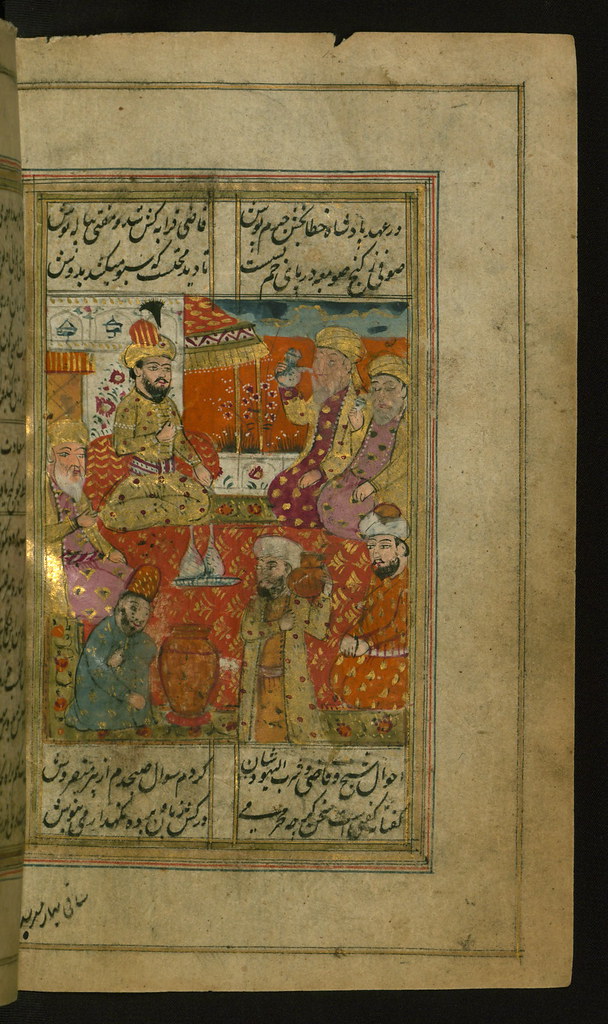
The poem also influenced Persian miniature painting (which depicted its scenes in elaborate detail), Ottoman Sufi literature, and, through translations in the twentieth century, Western readers and theater practitioners. Peter Brook’s acclaimed theatrical adaptation brought the poem to international audiences unfamiliar with Persian, demonstrating that its central question is genuinely universal.
That question is simply this: if you set out to find the divine, what do you discover about yourself?
The answer Attar gives, radical and consoling in equal measure, is that the journey and the destination were never two different things. The thirty birds who sought the Simurgh across seven terrible valleys were always the Simurgh. The seeker contains the sought. The question was always already the answer, waiting to be recognized.