Unlocking Persian Poetry: Your Complete Guide to Sufi Symbols
Why You Need a Symbolic Vocabulary
When you first open a collection of Hafez or Rumi in translation, you enter a world dense with wine, with an elusive beloved, with taverns, cupbearers, roses, and nightingales. A reader encountering this poetry for the first time might wonder: what is actually being said? Is this a love poem? A drinking song? A mystical text? The answer (famously) is all three at once, and none of them quite as they first appear.
Persian classical poetry (roughly 900 to 1500 CE) developed a remarkably coherent symbolic language shared across generations of poets. To read Hafez without this vocabulary is like trying to read musical notation without knowing what the symbols mean: you can sense that something meaningful is happening, but you cannot hear the music. This guide gives you that vocabulary.
One word of caution before we begin. These symbols are not a code to be cracked. Learning them does not mean you can now mechanically decode every line. Rather, they give you a sensitivity to the resonances that a reader steeped in this tradition would have felt naturally. The symbols work on you before you work on them.
Why Symbolic Language?
The Sufi tradition, which profoundly shaped the great poets of Iran, taught that direct language cannot capture divine love. God (al-Haqq, the Real) cannot be named without immediately reducing the infinite to a container. So the poets turned to images: the wine-drunk heart, the moth consumed by flame, the reed crying for the reed bed. These images do not try to explain love; they enact it. You feel the longing in the reed’s cry before you understand it intellectually.
There was also a practical dimension. Mystical ideas were sometimes politically dangerous in the societies where these poets lived, and a poem about a beautiful beloved or the pleasures of the tavern offered plausible cover for ideas that a straightforward theological treatise might not have survived.
The Core Symbols
Wine (می / باده)
Wine is perhaps the most famous and most misunderstood symbol in all of Persian poetry. It represents divine love and spiritual intoxication: the overwhelming, reason-dissolving experience of encountering the divine. When Hafez reaches for wine, he is writing about a state that lies beyond ordinary rational thought.
The opening couplet of Hafez’s most celebrated ghazal begins with a line of Arabic before continuing in Persian:
الا یا ایها الساقی ادر کأسا و ناولها که عشق آسان نمود اول ولی افتاد مشکلها
“O cupbearer, pass the cup and pour it around, for love seemed simple at first, and then all its difficulties arrived.”
The cup (کأس) is simultaneously the cup of fellowship and the vessel of divine grace. That love “seemed simple at first” before revealing its hardships captures the entire arc of the Sufi path: the initial intoxication is real, but the journey that follows demands everything.
The Beloved (معشوق)
The beloved in Persian Sufi poetry is almost never simply a human lover. The beloved is divine beauty itself (God encountered through the face of the beautiful, through the experience of being undone by something immeasurably greater than yourself). The beloved’s cruelty and apparent indifference mirrors the way the divine seems hidden or absent. The beloved’s beauty mirrors the overwhelming reality of the Real.
It is important to note that the poets rarely separated the human and divine beloved into neat categories. Hafez and Rumi often allowed these meanings to shimmer into each other, so that a verse about longing for a human beloved is simultaneously a verse about longing for God, and neither reading cancels the other.
The Tavern (میخانه)
The tavern (میخانه, literally “wine-house”) stands in deliberate contrast to the mosque. Where the mosque represents formal, legalistic religion, the tavern represents sincere, experience-based spirituality. In Hafez’s poetry especially, the tavern is associated with the “magi” (مغان), the ancient Zoroastrian priests, whose fire-temples became in Sufi symbolism emblems of authentic spiritual fire that burns without institutional mediation.
Hafez writes:
دلم ز صومعه بگرفت و خرقه سالوس کجاست دیر مغان و شراب ناب کجا
“My heart has wearied of the cloister and the hypocrite’s robe, where is the temple of the magi, and where is the pure wine?”
The صومعه (the Sufi lodge or cloister) inhabited by the سالوس (the hypocrite) stands for performed religiosity. The دیر مغان (the temple of the magi) stands for sincere spiritual thirst. The question “where is it?” expresses both longing and critique simultaneously.
The Cupbearer (ساقی)
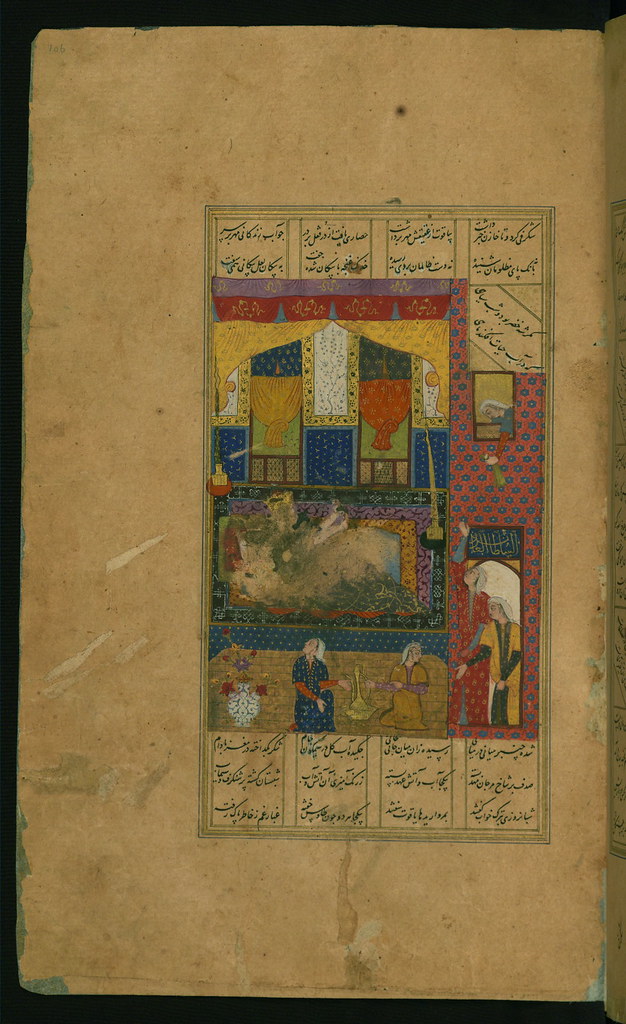
The ساقی is the one who pours the wine. In Sufi symbolism, the cupbearer is the spiritual guide or master: the one who mediates divine grace to the seeker. To address the ساقی in a poem is to address the teacher, or God in the guise of giving. The cupbearer’s act of pouring is the act of initiation.
The Rose (گل) and the Nightingale (بلبل)
This is one of the most beloved pairings in Persian poetry. The rose (گل) represents divine beauty and the beloved. The nightingale (بلبل) represents the mystic or lover who circles the rose’s beauty, singing in longing and pain. The nightingale’s night-song is both grief (it cannot possess the rose) and ecstasy (it circles something infinitely beautiful).
This pair encapsulates the Sufi understanding of love: suffering and joy are inseparable. The nightingale does not stop singing because it cannot hold the rose. It sings precisely because of that impossibility.
The Mirror (آیینه)
In Sufi thought, the human heart, when polished through spiritual practice and the abandonment of ego, becomes a mirror that reflects divine reality. This image draws on the ancient use of polished metal as a mirror. A tarnished mirror reflects nothing; a polished one reflects everything clearly. The spiritual life, in this metaphor, is fundamentally the work of polishing.
The Candle (شمع) and the Moth (پروانه)
The candle represents divine light: beautiful, warm, and annihilating for those who draw too close. The moth (پروانه) represents the soul that seeks union with the divine at the cost of its own existence. To be consumed by the flame is, in the Sufi framework, the highest achievement: فنا (fana), the annihilation of the self in God.
Attar captures the total nature of this surrender:
از می عشقت چنان مستم که نیست تا قیامت روی هشیاری مرا
“From the wine of your love I am so drunk that until the Day of Judgment there is no prospect of sobriety for me.”
The permanence matters here. This is not a passing mood but a total reorientation of being. The soul that has tasted divine love cannot return to ordinary wakefulness.
The Reed Flute (نی)
The opening of Rumi’s Masnavi (the greatest long poem in the Persian Sufi tradition, composed between approximately 1258 to 1273 CE) takes the reed flute as its governing image:
بشنو این نی چون شکایت میکند از جداییها حکایت میکند
“Listen to this reed, how it tells of separations, how it narrates the stories of severances.”
The reed (نی) is cut from the reed bed. Its music is the cry of that severance. In Rumi’s metaphysical framework, the reed is the human soul separated from its divine origin (the reed bed) and now crying for reunion. Every human being is, in this reading, a reed flute: we make music, but only because we have been cut from our source.
Curls and Hair (زلف)
The beloved’s curls are a symbol of the snares and entanglements of divine beauty. To be caught in the beloved’s hair is to be helplessly captivated by God. The curls are dark, numerous, and labyrinthine: they represent the bewildering complexity of the divine presence, the way love tangles you up and disables ordinary life. In this symbol, captivity is not a loss but the beginning of wisdom.
Literal and Symbolic: Both at Once
A crucial insight for new readers is that these symbols rarely function on a single level. When Hafez writes about wine, he is usually not choosing between “divine love” and “actual wine.” He writes in a way that holds both meanings simultaneously. Earthly beauty points to divine beauty. Human longing mirrors the soul’s longing for God. This layering is not evasion; it is the poets’ philosophical position. Earthly beauty is a genuine reflection of divine beauty, and to love the reflection is already to begin loving the original.
This is why Persian poetry so often feels both sensual and spiritual at once, why it can be read as mystical verse by one reader and as elegant love poetry by another, without either reading being simply wrong.
Attar captures how authentic religious thinkers understood this duality when he writes about the complete overthrow of conventional religious categories:
چون نیست هیچ مردی در عشق یار ما را سجاده زاهدان را درد و قمار ما را
“Since there is no real man of courage to be found in love with our beloved, let the ascetic keep his prayer-rug, and leave the pain and the gamble to us.”
The prayer-rug of the formal ascetic and the “gamble” of the lover occupy entirely different moral universes. The poets are not mocking piety; they are insisting that genuine surrender to the divine cannot be acquired through ritual alone.
Reading Slowly
Learning these symbols gives you a new way to enter the poetry. When you read Hafez’s lines about the dark night and the fearful whirlpool, you will now feel the spiritual emergency underneath:
شب تاریک و بیم موج و گردابی چنین هایل کجا دانند حال ما سبکباران ساحلها
“A dark night, fear of the wave, and a whirlpool as fearful as this, how can those who travel light along the shore know our condition?”
The poem is about spiritual crisis. It is also about the loneliness of the serious seeker: those who have not entered the depths cannot understand those who have. The symbolic vocabulary does not close down the poem; it opens it outward. Read slowly, and let the images do their work.